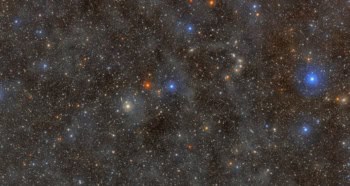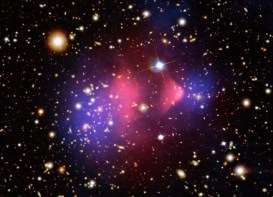
In the arena of public engagement, astronomy holds one distinct advantage over other areas of physics: the ability to generate an endless supply of pretty pictures. But not all astronomers benefit equally from this superpower – when it comes to capturing the punter’s imagination, it is optical astronomy that reigns supreme. Whether it’s the latest image of the Horsehead Nebula from the Euclid telescope or Voyager’s “Pale Blue Dot” photograph, this narrow band of the electromagnetic spectrum dominates public discourse on outer space.
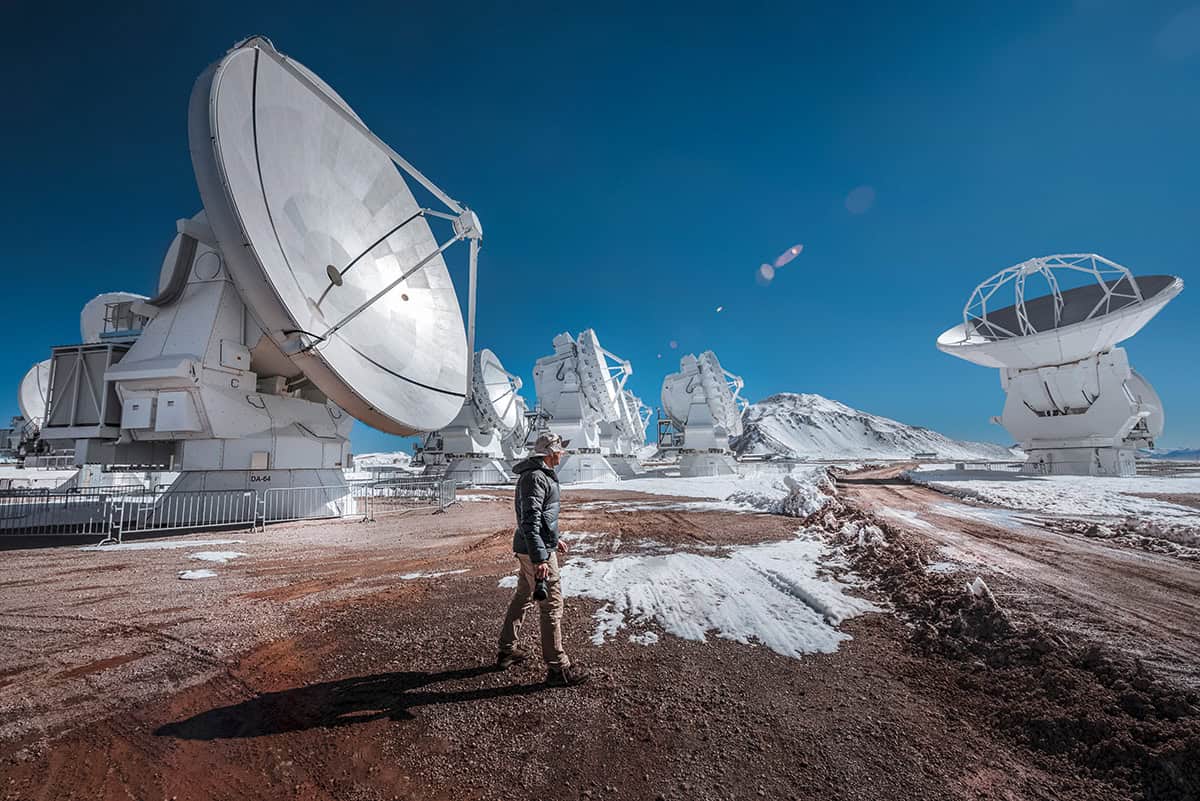
It is with this in mind that astrophysicist and author Emma Chapman’s latest book is especially pertinent. A love letter to long-wavelength astronomy, Radio Universe: How to Explore Space Without Leaving Earth sheds a new (non-optical) light on a powerful and often overlooked tool in science: the radio wave.
Chapman takes us on a cosmic tour, starting with planet hopping across our solar system, before diving through the spiral arms of the Milky Way to explore black holes, neutron stars and the origin of our universe. At each stop, our tour guide outlines all that radio wavelengths have taught us about these phenomena, with humour and endearing appreciation. She also highlights some of the uphill battles for recognition fought by radio astronomers over the years.
Throughout the book, Chapman effectively outlines distinct advantages of radio waves over the visible spectrum. For starters, they are unattenuated by Earth’s atmosphere and dust in the intergalactic medium. This allowed radio astronomers to see further into both space and time; and with less expensive instruments. Moreover, a radio telescope’s ability to make observations is not hampered by bad weather – indeed, they can happily continue collecting data at day or night.
As Chapman explains, many of humankind’s biggest achievements are indebted to the radio wave. When astronauts first walked on the Moon in 1969, they relied on radio communications to keep them on course, while their safe landing site had already been selected from detailed maps of the lunar surface assembled by radar (radio detection and ranging).
As we fly with Chapman through the inner solar system, some of radio’s biggest strengths are highlighted in contrast to other means of exploration. Take Venus. Scientists in the Soviet Union admirably sent wave after wave of space probes (14 in total) as part of the Venera programme (1966–1982). Each one lasted mere minutes or hours on the surface before being crushed by the hellish pressures and temperatures of the Venusian atmosphere. Meanwhile, radar facilitated far more efficient surveys of the surface by both Russian and US spacecraft in orbit around the planet.
Chapman also explains how, in 1956, radio astronomers provided the first realistic (and apocalyptic) picture of life on Venus. This was in stark contrast to the earlier infrared-based measurements, which had suggested a tranquil and potentially life-supporting environment. It was later clarified that the infrared waves originated from the top of the Venusian atmosphere, whereas the longer wavelengths of radio revealed the nightmarish conditions below.
Chapman goes on to outline in astonishing detail all that radio waves have taught us about the best places to set up camp on Mars. Radar surveys of the Red Planet have uncovered secret caverns below the surface, which will provide future colonisers with access to subterranean water deposits and shelter from high-energy solar particles. Her coverage of this topic, in particular, is a masterclass in making science engaging, with Chapman playing the role of a Martian real-estate agent – “Valles Marineris is a very up-and-coming area, don’t you know?” – and I for one think she could be up for employee of the month.
Radio astronomy: from amateur roots to worldwide groups
A consistent and thought-provoking theme that emerges in Radio Universe is “seeing is believing”. On several occasions in history, we find radio-based discoveries requiring confirmation with some other “more visible” means of investigation as a prerequisite for widespread acceptance by the field. For example, it was not until we saw the first waveform of a gravitational wave detected by the LIGO detectors, in 2016, that these predictions of general relativity were considered confirmed. This was despite the indirect detection of gravitational waves through radio observations of pulsars more than four decades earlier.
Chapman highlights the emotional impact on the astronomy community, and the world as a whole, of the first image of a supermassive black hole, assembled with radio interferometry and unveiled in 2019 by the Event Horizon Telescope. Even with all of the faith we as scientists place in Einstein’s theory of gravity, the photographic proof of these unimaginable phenomena still resonated. As Chapman aptly puts it, “a picture tells a thousand equations”.
The book also highlights the ideological battles fought by radio practitioners over the years, from confirming the temperature of Venus to validating the Big Bang theory itself. One can’t help but wonder if this visible-centric view of the world is to blame for the apparent “radio scepticism”. Or is just a case of new kid on the block, given that radio astronomy only began in the mid 20th century, while optical imaging dates back much further?
Whatever the reason, this optical astronomer comes away from Chapman’s latest book with a newfound respect and appreciation for the longer wavelengths. And as far as Martian real-estate ventures go, sign me up for one of the new builds on Utopia Planitia. After all, the property prices can’t be as bad as inner-city UK living, can they?
- 2026 John Murray Press £25hb 352pp